Opening Burundi’s fertiliser market
A foreign-exchange crisis had left Burundi’s farmers short of fertiliser. We worked with the government on the policy and licensing that open imports to the private sector, and brought in three suppliers ready to deliver.
Burundi imports almost all of its chemical fertiliser, and every tonne has to be paid for in foreign currency. By the end of 2025 the country’s reserves had fallen to about $214 million, roughly seven weeks of imports, according to the IMF. Fertiliser joined fuel on the list of things the economy could not reliably buy.
Farmers felt it first. In early 2026, growers in Gitega reported that urea and organo-mineral fertiliser arrived late and short, some receiving only part of what they had paid for. By mid-year FEWS NET was reporting that lower fertiliser use had limited yields from the start of the season. Farmers had no lawful way to bring in fertiliser themselves, so the shortage ran straight into the harvest.
A permission on its own does not put fertiliser in the ground, and suppliers will not commit to a market that is closed to them. So we worked both sides at once.
With government, Exalt Policy worked on the policy and the licence. We made the case that the private sector could carry part of the import burden, so that farms and cooperatives with their own access to finance were no longer waiting in the queue for scarce official foreign exchange. Then we worked on the licensing route that lets them import under the Ministry’s oversight: who may apply, what each application must declare, and which fertilisers are allowed in.
With industry, we identified and brought in three companies able to supply Burundi once the rules allowed it, so that the decision would be met with product rather than paperwork.
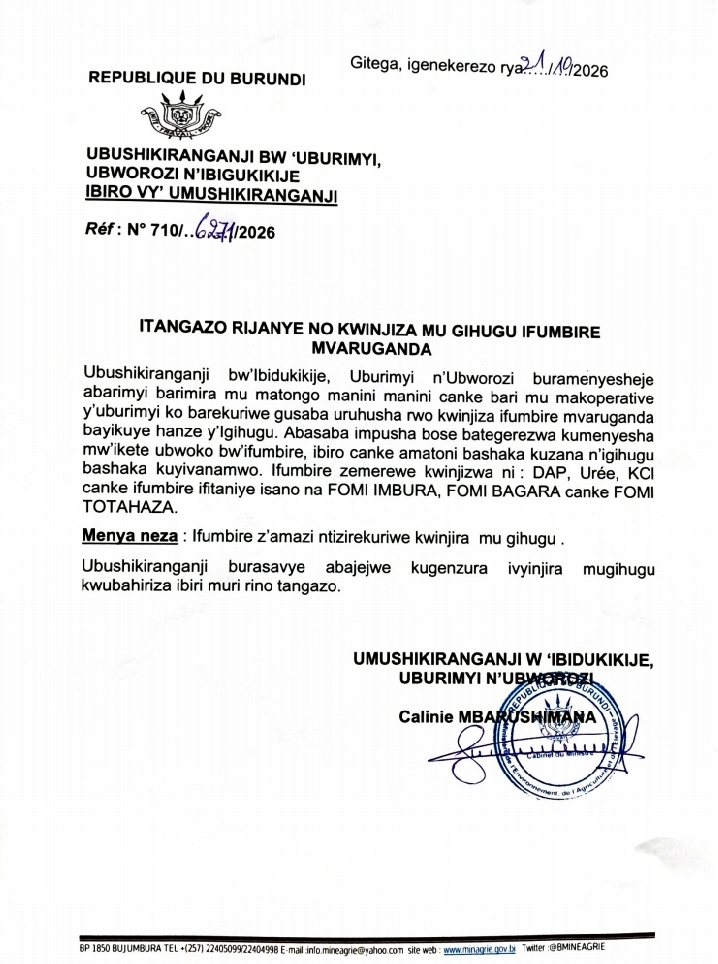
Our translation, summarised.
- Who may import.Large-scale farmers, and farmers organised in agricultural cooperatives, may now apply for permits to import the chemical fertiliser they need from abroad.
- How.Each application states the type of fertiliser, the quantity in kilograms or tonnes, and the country it will be imported from.
- What.DAP, urea and KCl (potash) are permitted, as are fertilisers equivalent to the FOMI Imbura, Bagara and Totahaza blends.
- What not.Liquid fertilisers remain barred from import.
- Enforcement.The Ministry instructs the authorities who control imports to apply the notice.
Signed by Calinie Mbarushimana, Minister of Environment, Agriculture and Livestock.
Burundi’s larger farms and its cooperatives can now source fertiliser on their own account, through a licensed channel the government still oversees. Three suppliers are ready to deliver. Every tonne that comes in privately also eases the pressure on the official allocation, which leaves more for the smallholders who rely on it.
- Openedprivate fertiliser imports
- 3suppliers brought in
- DAP, urea, KClauthorised
Sources
- Ministry of Environment, Agriculture and Livestock of Burundi, public notice on the import of chemical fertiliser, Réf. N° 710/6271/2026, Gitega, 21 October 2026 (shown above)
- KT Press: Burundi international cash reserves critically low at $214m, IMF
- Fertilizer Daily: Fertilizer shortage in Burundi raises fears of food crisis
- FEWS NET: Burundi key message update, July 2026
